Taking a Construction Contract Job? Get These Six Details in Writing First
Taking a Construction Contract Job? Get These Six Details in Writing First
Summary
There is a particular kind of phone call that happens a lot in contract work. It goes something like this: "Great news, they want you. Can you start Monday?"
It's exciting. It's flattering. And it is exactly the moment to slow down for about ten minutes and get a few things in writing.
Not because anyone is trying to catch you out. Most of the time, everyone involved is acting in good faith. But good faith and good memory are two different things, and when details only exist in a phone call, they have a funny habit of changing shape by week three.
Why written beats remembered
Contract and project-based work is a big part of how US construction runs. The Bureau of Labor Statistics counts 862,000 workers provided by contract firms across the economy, alongside millions more in other alternative arrangements. Every one of those assignments starts with some kind of agreement, and the clearer it is, the smoother everything else goes.
A written summary protects everyone. It protects you from surprises. It protects the client from misunderstandings. And it gives everybody the same reference point when a question comes up, which it will.
You do not need a fifty-page contract to get there. An email that confirms the key details, and that you have read properly, is a very good start.
1. The actual duration
Ask how long the assignment is expected to run, and what that estimate is based on. A phase? A package? A fixed end date? Then ask what happens if the schedule moves, because schedules move.
The important word here is "expected". Durations in construction are estimates, and an honest recruiter or client will tell you that. What you want in writing is the planned length, the notice either side would give if it ends early and who confirms any extension. Do not assume an extension is automatic, however busy the site looks.
2. The hours
Ask what a normal week looks like. Start and finish times, days per week, whether weekend or night work is likely and how overtime is handled.
If you are paid as a non-exempt employee, federal law says covered employees must receive overtime at not less than time and a half for hours over 40 in a workweek. But your arrangement might be different, and state rules can add to the federal ones. So do not assume. Ask how your hours will be recorded, who approves them and how overtime is paid on this assignment specifically.
3. The location, precisely
"Texas" is not a location. Neither is "the project". Get the site address, where you report on day one and whether the work might move between sites during the assignment.
This matters more than it sounds. A site forty minutes from where you are staying is a very different daily life from one five minutes away. And on large campuses, "the site" can cover a surprisingly large patch of ground.
4. Expenses: what is covered, and how
If the assignment involves travel, get the expense arrangements in writing before you book a single thing. Travel to site, accommodation, daily costs, mileage and how and when you claim them.
The IRS explains how it treats travel away from home and temporary work assignments in Publication 463, and it is worth a read if you travel for work regularly. But the arrangements for your particular assignment come from the people offering it, not from a general guide. If something is not covered, it is far better to know now than to discover it on your first expense claim.
5. The engagement structure
This is the one people skip most often, and it matters a lot. Ask exactly how you are being engaged. Are you an employee of the staffing firm, an employee of the client or an independent contractor? Who pays you, and how often? Who handles tax withholding?
The difference is not just paperwork. The IRS decides whether someone is an employee or an independent contractor by looking at the whole relationship, including behavioral control, financial control and the type of relationship. The Department of Labor also has guidance on employee misclassification. You do not need to become an expert. You just need to know which arrangement you are being offered, so you understand what it means for your pay and taxes.
And a gentle word of caution: do not assume benefits you have not been told about. If insurance, paid time off or anything else is part of the package, it should be written down. If it is not written down, ask.
6. Who answers your questions
Finally, ask who you call when something comes up. On day one, if you cannot find the gate. In week two, if your hours look wrong. In month three, if the scope starts to drift.
Often this is more than one person: a site supervisor for the work and a recruiter or agency contact for pay, hours and assignment questions. That is fine. Just get the names and numbers in writing, so you are not guessing when you need them.
How to ask without sounding difficult
Some people worry that asking for details in writing will make them look awkward or demanding. It will not. Experienced recruiters and clients expect these questions from experienced professionals. If anything, it signals that you take the work seriously.
A simple line does the job. "Could you confirm the duration, hours, site address, expenses, engagement structure and contacts by email so we are all working from the same page?" Friendly, clear and very hard to object to.
Red flags worth noticing
Most assignments are straightforward. But a few signs are worth pausing on. Pressure to accept before any details are shared. Vague answers about who is actually employing you. Expense arrangements that are "to be sorted out later" for travel you are expected to book now. Or a reluctance to put anything in writing at all.
None of these automatically means something is wrong. They do mean it is worth asking a second time, calmly, before you say yes.
Keep it somewhere you can find it
Once the details are confirmed, save them somewhere sensible. A folder in your email, a note on your phone, a screenshot you will not delete by accident. It sounds obvious, but when a question comes up on a Thursday night in a hotel room, you will want the answer in ten seconds, not ten minutes of scrolling.
And if anything changes during the assignment, such as new hours, a different site or an extension, ask for that in writing too. The same habit that protected you at the start keeps protecting you all the way through.
Your checklist
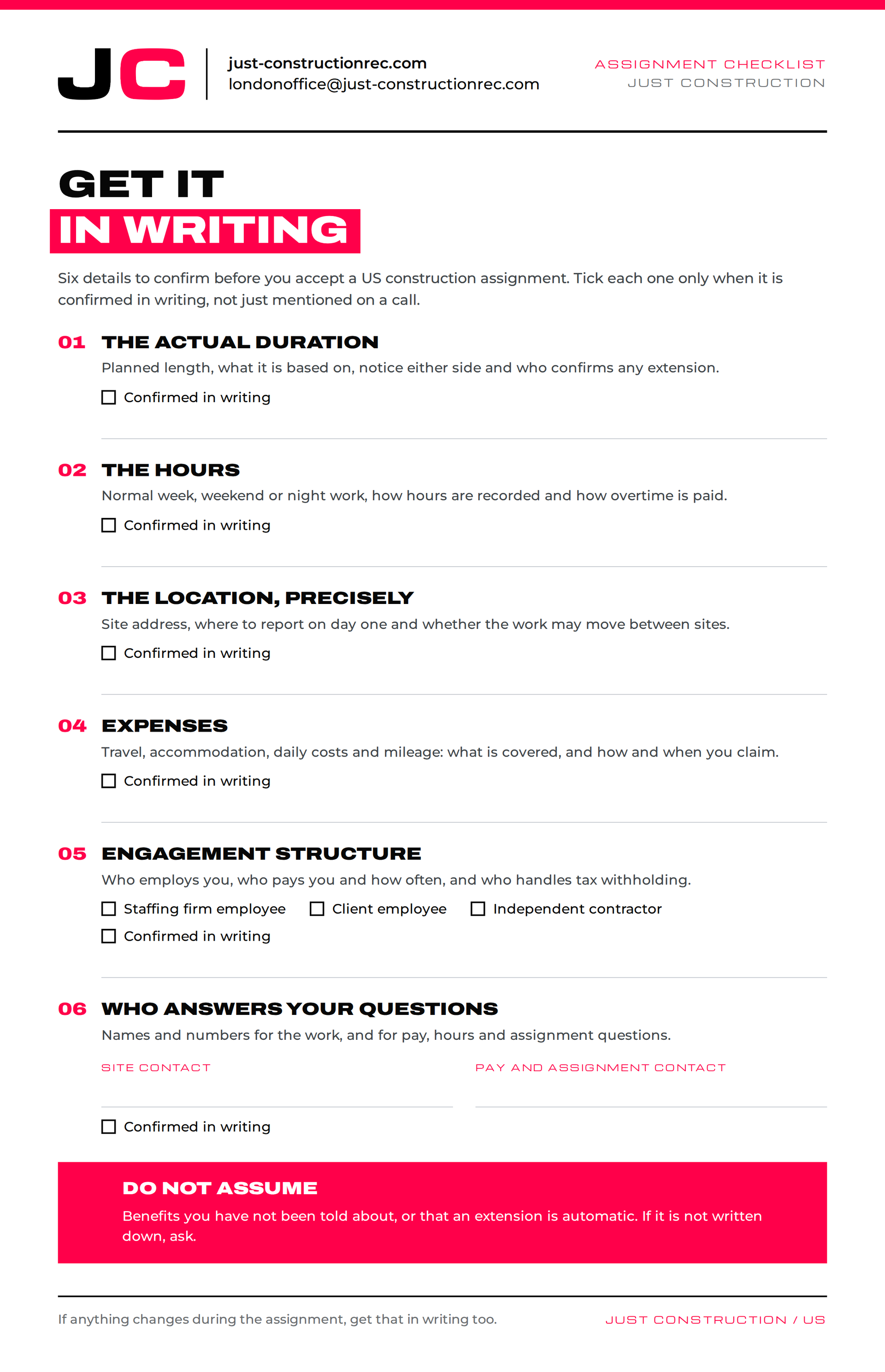
We have put all six into a checklist you can keep on your phone or print out. Duration, hours, location, expenses, engagement structure and contacts. Tick each one off only when it is confirmed in writing, not just mentioned on a call.
How we help
Our contract team is led by Jodi Searle, our Head of Contract Staffing. When Jodi's team presents an assignment, we aim to give you these details clearly and in writing, and to tell you honestly when something is not yet confirmed. If you are open to US contract work, you can share your preferences and availability with us any time, or email Jodi directly at jodi@just-constructionrec.com. We have also written about how project-based work is reshaping construction careers, if you are weighing up whether contract work is right for you.
"Can you start Monday?" is a great question to hear. Just make sure you can answer six of your own first.
Take the next step
If you are a business looking to for your next hire, a candidate looking for a new opportunity or just want industry information, get in touch.



READ MORE ARTICLES