The Estimator's Job Just Got Harder
The Estimator's Job Just Got Harder
Summary
Let us start with a small appreciation for the estimator.
Every project you have ever won started with someone quietly working through drawings, specifications and quotes, trying to work out what a building will cost before anyone has built it. If they get it wrong one way, you lose the bid. If they get it wrong the other way, you win the bid and spend the next eighteen months wishing you hadn't. No pressure.
And right now, the job is getting harder. Not because of any single price or product, but because of workload, talent supply and a hiring process that often struggles to tell a good estimator from a confident one.
More to price, from a pool that is not growing
The Bureau of Labor Statistics projects employment of cost estimators to decline 3 percent between 2025 and 2035, while still expecting about 17,600 openings a year, all of them from people retiring or moving to other occupations. In plain English, the pool is not getting bigger, and experienced people keep leaving it.
Meanwhile, the pipeline of work to price keeps moving. The Dodge Momentum Index, which tracks nonresidential projects entering planning, was up 4.2 percent year over year in August 2026, with 31 projects worth $100 million or more entering planning that month alone. Every one of those projects needs somebody to price it, often several times over as designs change.
Put those two things together and you get a very familiar picture. Estimating teams stretched thin, bids competing for the same few people and a lot of hiring managers wondering why their estimator ad has been open for two months.
Start with the scope, not the title
"Estimator" covers a remarkable range of jobs. A preconstruction estimator shaping early budgets with a design team does very different work from a trade estimator pricing an electrical package from complete drawings. A senior estimator leading bid strategy is doing a different job again.
So before you write the ad, answer a few questions. What stage of the project will this person price: conceptual, design development or hard bid? Which trades or packages will they cover? Will they price self-performed work, subcontracted work or both? Will they lead bids, support a lead estimator or manage a team? And who do they hand the estimate to once it is won?
Those answers change who you are looking for more than the job title ever will. They also make your ad far more attractive to the right people, because experienced estimators can tell at a glance whether a role fits what they actually do.
Be honest about the workload
Here is where a lot of estimator hires go wrong. The workload in the job description and the workload in real life are two different animals.
If the role involves pricing a certain number of bids a month, say so. If most of them are quick-turnaround hard bids, say that too. If the team is currently short and the new hire will be catching up on a backlog, it is far better to be upfront than to find out in week three that your new estimator is quietly updating their resume.
Honesty here is not just polite. It is practical. Experienced estimators know what a sustainable workload looks like, and they will ask. A clear answer builds trust. A vague one tells them the answer is probably "too many."
Screen for evidence, not confidence
Estimating is one of those skills that is easy to talk about and hard to fake in practice. So the interview should be built to find evidence, not just enthusiasm.
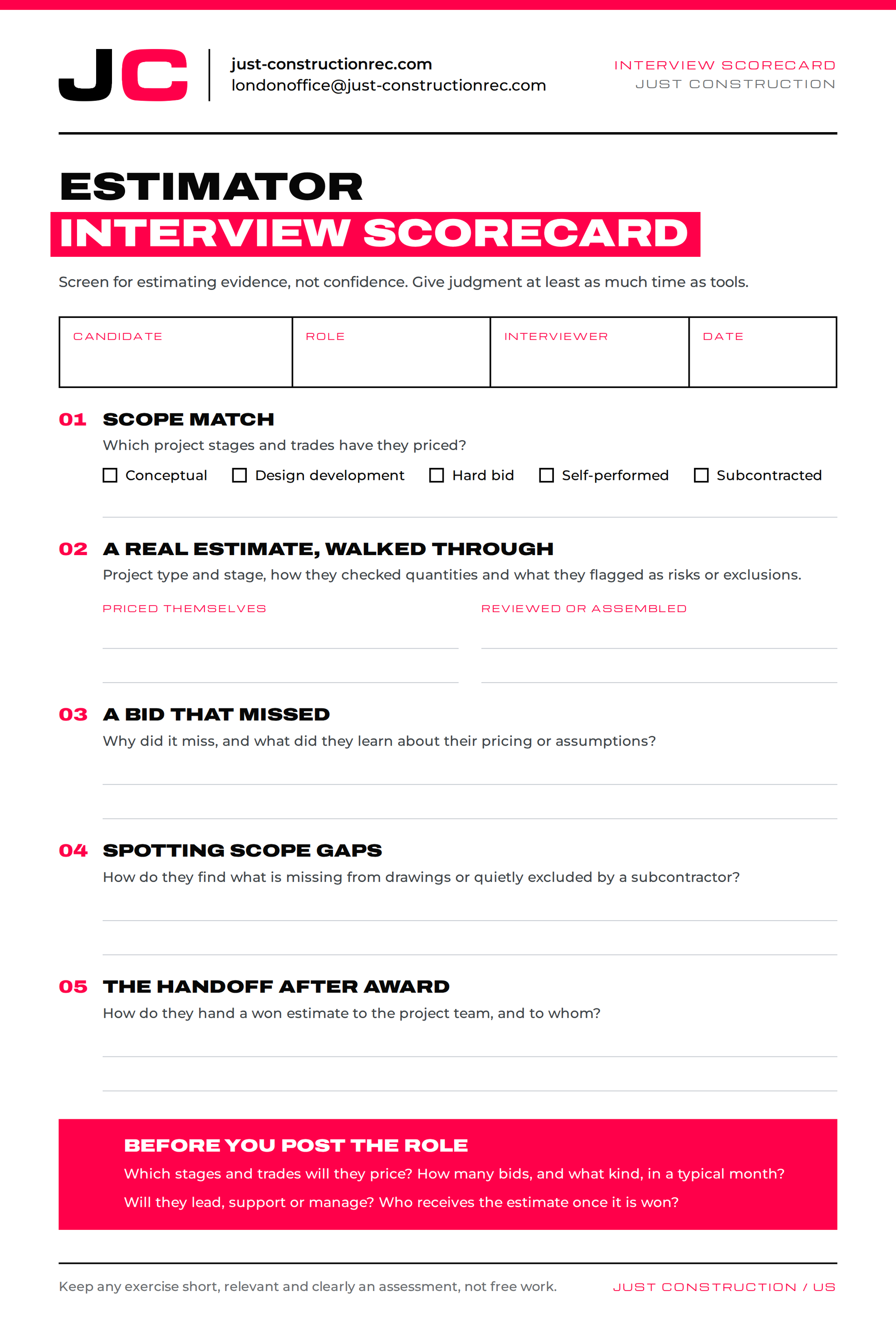
Ask about a specific estimate they built. What was the project type and stage? Which packages did they price themselves, and which did they review or assemble from subcontractor quotes? How did they check their quantities? What did they flag as risks or exclusions?
Ask about a bid that did not go their way, too. Why did it miss? What did they learn about their pricing or assumptions? Good estimators usually have a thoughtful answer, because they have spent time wondering about it.
And ask how they handle scope gaps. Spotting what is missing from a set of drawings, or what one subcontractor has quietly excluded, is one of the most valuable skills an estimator has. A candidate who lights up at this question is usually a candidate worth a second conversation.
Check the handoff too
One question that rarely makes it into estimator interviews: what happens to your estimate after the bid is won? The best estimators think beyond bid day. They document assumptions, qualifications and exclusions clearly enough that the project team can actually use them, rather than reverse-engineering the number three months later.
Ask candidates how they hand over a won estimate and to whom. Someone who talks about turnover meetings, clear notes and staying available for questions is someone your project managers will thank you for hiring.
A practical exercise, kept fair
Many hiring teams use a short estimating exercise, and it can be genuinely useful. A small takeoff or a review of a sample bid shows how someone thinks far better than a list of software on a resume.
Just keep it fair. Make it short, relevant to the actual role and clearly an assessment rather than free work on a live bid. Tell candidates in advance what it involves and how long it should take. Strong candidates in a tight market will not spend a weekend on an unpaid project, and they should not have to.
Tools matter, judgment matters more
Estimating software and digital takeoff tools are now part of the everyday job, and fluency with them is a real advantage. We have written about how digitally fluent construction professionals are increasingly hired first, and estimating is a clear example.
But software does not decide what a project will cost. People do. A candidate who can explain why a number looks wrong is more valuable than one who can simply produce a number quickly. When you interview, give at least as much time to judgment as to tools.
Why this matters more now
The cost of a weak estimator is rarely visible on day one. It shows up months later, in a project that was underpriced, a scope gap that became a change order dispute or a bid that was lost by a margin nobody can explain.
Pricing conditions have not made the job any easier either. Long lead times and shifting equipment availability, which we explored in The Equipment Is the Problem, Not the Contractor, mean estimates need more assumptions, more qualifications and more careful communication with the operations team that inherits them.
A quick estimator hiring checklist
Before you post the role, check that you can answer these. Which project stages and trades will they price? How many bids, and what kind, in a typical month? Will they lead, support or manage? Who receives the estimate after it is won? And what evidence will you ask for in the interview: a walkthrough of a real estimate, a missed bid and how they spot scope gaps? We have put these into a printable scorecard below.
How we help
When we recruit estimators for US construction clients, we start with the scope and the workload, then screen for real estimating evidence before a candidate reaches your shortlist. If you have an estimating role to fill, or one that has been open far too long, we would be glad to
talk it through.
The estimator's job just got harder. Hiring one does not have to.
Take the next step
If you are a business looking to for your next hire, a candidate looking for a new opportunity or just want industry information, get in touch.



READ MORE ARTICLES