Who Owns the Handoff? Defining Data Center Hiring Responsibilities
Who Owns the Handoff? Defining Data Center Hiring Responsibilities
Summary
On a data center project, the owner, general contractor, MEP contractors and commissioning team all hire people, and the handoffs between them are where responsibilities blur. We share a simple hiring responsibility map to agree who defines each role, who approves it and who the hire hands off to.
Here is a question that can make a data center project meeting go very quiet: who is hiring for that?
Not in a sinister way. Just in the way that happens when four organizations are building one facility and each of them assumes a particular role sits with one of the others. The owner thinks the general contractor has it covered. The general contractor thinks it belongs to the MEP contractor. The MEP contractor thinks commissioning will sort it out. And commissioning is busy writing test scripts, blissfully unaware it has been volunteered.
Nobody is being careless. The boundaries on a data center project are genuinely blurry, especially at the handoffs. This article is about making them less blurry before the hiring starts.
Four teams, four sets of hires
Most data center projects involve four broad groups, each hiring for its own reasons. Every project labels them slightly differently, so treat this as a map rather than a rulebook.
The owner or operator hires to protect the program. Owner's project and program managers, owner's representatives and, increasingly early, the operations people who will run the facility once it is built.
The general contractor hires to deliver the contract scope. Project managers, superintendents, project engineers and the coordination roles that keep trades moving. We have written about what a general contractor is actually supposed to be good at now, and on data centers the answer leans heavily on sector depth.
The MEP and specialty contractors hire to deliver their packages. Electrical, mechanical, controls, fire and structured cabling specialists, plus the foremen and project managers who run those packages. On these projects, MEP professionals hold a lot of leverage, because so much of the facility's value sits in its systems.
The commissioning team hires to prove it all works. Commissioning agents, engineers and technicians who plan and run the tests that turn installed equipment into a verified facility.
The trouble lives at the handoffs
Inside each team, hiring is usually clear enough. The trouble starts where the work passes from one team to another.
Take the move from construction into commissioning. Somebody needs to own test readiness, track open items and make sure documentation is ready. Is that a general contractor role, an MEP contractor role or a commissioning role? On one project it might be all three, overlapping. On another it might be none of them, and the gap only shows up when testing stalls.
Or take the move from commissioning into operations. Commissioning frameworks such as ASHRAE Guideline 0 emphasize training for the operating team and a documented process that runs right through to occupancy. That training needs someone to deliver it, someone to receive it and someone to make sure the people receiving it have actually been hired in time. That last part is easy to miss.
Why it matters for hiring
When responsibilities are blurry, two things tend to happen. Either two organizations hire for the same job, which is expensive and awkward, or nobody hires for it, which is expensive and late.
And the people involved are not easy to find in a hurry. Uptime Institute's 2025 survey found that nearly two-thirds of data center operators report difficulty retaining staff, finding qualified candidates or both, and that senior roles have become harder to fill than entry-level ones. That survey covers operators, but anyone recruiting on the build side will recognize the pattern. A role discovered late is a role filled in a rush.
Blurry responsibilities also affect candidates. A strong candidate who is interviewed by two organizations for what sounds like the same job, or who cannot get a straight answer about who they would report to, starts to wonder how well the project is run. The best people in this market can afford to be choosy, and clarity is one of the things they choose on.
A simple hiring responsibility map
The fix is not complicated. Before hiring starts, sit the teams down and agree four things for every significant role, especially the ones that sit near a handoff. We have turned it into a map you can print and fill in together.
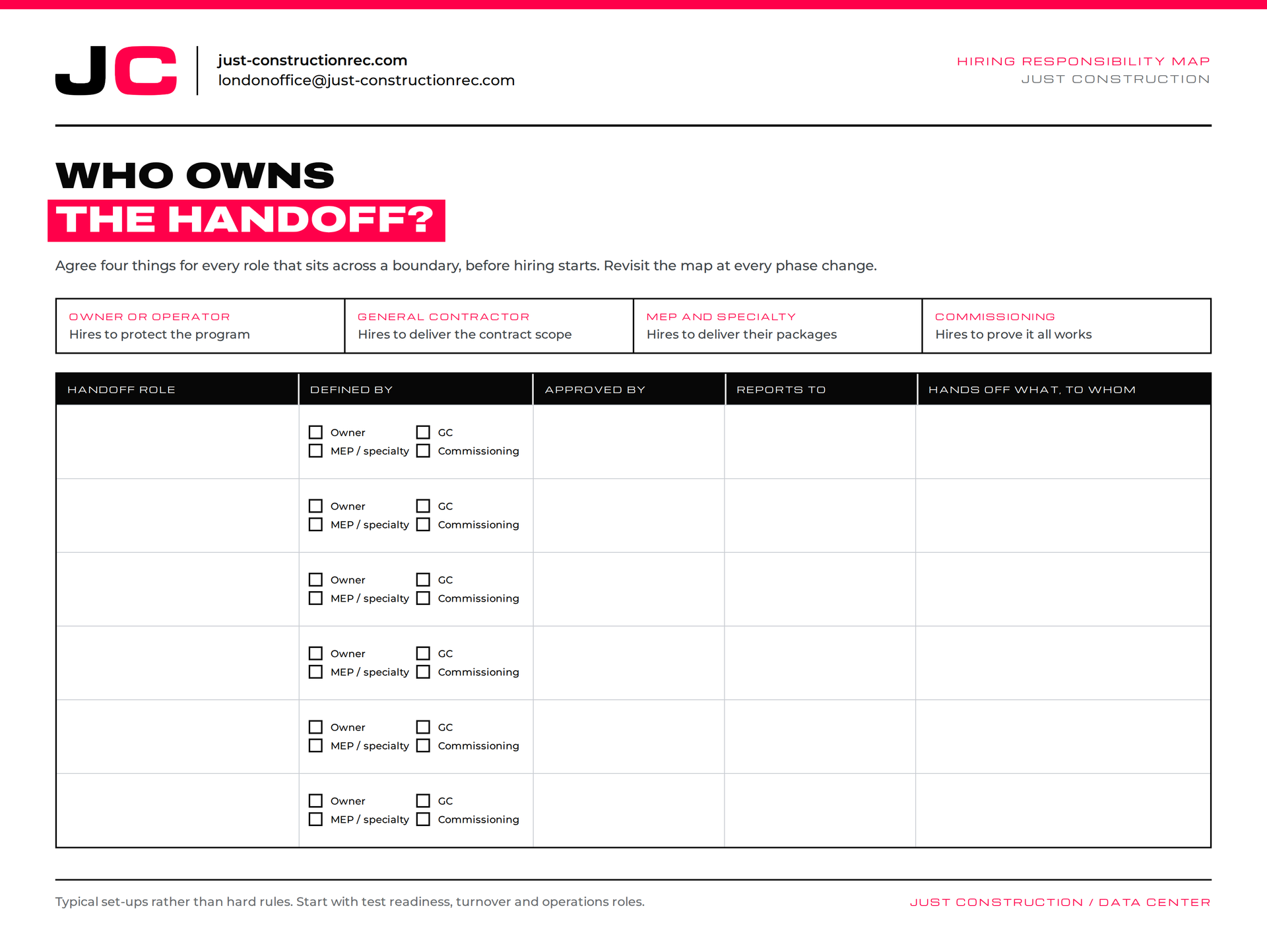
Who defines the role? The organization that writes the brief and decides what the hire will own.
Who approves the hire? The person who can say yes, by name.
Who does the hire report to? Day to day, not just on paper.
What do they hand off, and to whom? The work, documents or systems they pass on, and the team that receives them.
The map in action: a hypothetical example
To show how the map works, here is a clearly hypothetical example.
Imagine a role called test readiness coordinator on a new data hall. In the mapping session, the teams agree that the general contractor defines the role, because it sits within their scope for managing construction completion. The general contractor's project manager approves the hire. Day to day, the coordinator reports to the superintendent, but works closely with the commissioning agent. And they hand off a verified list of installed, documented systems to the commissioning team before functional testing begins.
Four answers. Suddenly everyone knows who is hiring, who signs off, who the new person listens to and what finished looks like. Without the map, that same role could easily have been advertised by two organizations, or by none.
Start with the handoff roles
You do not need to map every role on the project. Start with the ones that sit across a boundary. Test readiness and turnover coordination. Commissioning support on the contractor side. Operations staff who need to be in place before training begins. Owner's representatives who oversee work delivered by others.
These are the roles most likely to be claimed twice or not at all. Get them on the map first, and the rest of the hiring plan tends to fall into place around them.
Signs your responsibilities need mapping
A few warning signs are worth watching for. Two job ads from two organizations describe suspiciously similar work. A role keeps appearing in meeting notes but never in a hiring plan. Someone in a meeting assumes the other team is hiring for it. Or the operations team is being recruited after commissioning has already started.
If any of those sound familiar, a thirty-minute mapping session is probably the best use of your week.
Keep the map alive
A responsibility map is not a one-off exercise. Projects change, scopes move and packages get reassigned. Revisit the map at each phase change, particularly as construction winds down and commissioning ramps up. That is the moment when responsibilities shift most, and when a quick check can prevent a very slow month.
How we help
Our Mission Critical and Data Center team works with owners, general contractors and specialty contractors, so we see these handoffs from every side. When we take on a data center search, we start by confirming where the role sits on the map: who defined it, who approves it and who it hands off to. It is a small step that makes the whole search sharper.
So next time the room goes quiet after "who is hiring for that?", you will have an answer. Better still, you'll have it written down.
Take the next step
If you are a business looking to for your next hire, a candidate looking for a new opportunity or just want industry information, get in touch.



READ MORE ARTICLES