Put the Pay on the Post: The Case for Salary Ranges in Construction Job Ads
Put the Pay on the Post: The Case for Salary Ranges in Construction Job Ads
SUMMARY
Pay transparency laws now cover 14 states and Washington, DC, with Connecticut joining today, yet plenty of US job postings still leave pay out. We look at what candidates do with a blank, what the research says about pay, and how to set a range you can stand behind before your next role goes live.
On Tuesday we posted eight new roles across the US. A senior fire alarm technician in North Florida, a project manager for ornamental metal and glass in New York, an electrical project manager on a data center in Virginia, and five more in between.
Every one of them had a pay range on it, from $70K at one end to $220K at the other.
Here is the part we find interesting. Only three of those eight roles were in states where the law requires a range in the job ad: New York, Maryland and Virginia. The other five, in Florida, Tennessee, Georgia, Texas and North Carolina, could have said "competitive salary" and left it there, perfectly legally.
We posted the range anyway. This article is about why, and about how to set a range you can actually stand behind before your next role goes live.
The map keeps filling in
Pay transparency used to sound like a Colorado thing. Not anymore. Going by HR Dive's running tracker of pay transparency laws, 14 states plus Washington, DC now require pay ranges in job postings, with local rules on top in places like New York City, Westchester County, Jersey City, Ithaca, Cleveland, Columbus and Cincinnati.
This year has been busy. Virginia's law took effect on July 1, 2026, and it is not shy. It covers every job, promotion and transfer opportunity, asks for a good-faith minimum and maximum, and carries civil penalties of up to $5,000 for repeat violations. Maine followed at the end of July for employers with 10 or more employees. And as of today, Connecticut employers must include the wage or wage range and a general description of benefits in internal and external job postings. Delaware is next, in September 2027.
If you hire across several states, the practical upshot is simple. Pay ranges are becoming the default, and the states without a rule are starting to look like the exception. The details still vary by state and city, and they change often, so check the rules for each location with your own advisers before a role goes live.
Half the market still says "competitive"
For all that legislation, plenty of job ads still keep pay to themselves. Indeed reported that as of May 2025, 59% of US job postings on its site included salary information. Flip that around and roughly four in ten ads were still asking candidates to guess, in a market where the number is often the first thing a candidate looks for.
It is not hard to see why some employers hold back. A posted range can feel like showing your hand to competitors, or like inviting awkward conversations with the people already on your payroll. Both concerns are real. Neither goes away by leaving the number off. Candidates compare offers out loud, and your own team can read your job ads just as easily as anyone else.
And "competitive" has never told anyone anything. Competitive with what, exactly? The company down the road? The market in 2019? The hiring manager's own optimism?
What candidates do with a blank
Candidates do not read a missing number as neutral. In a Monster survey of more than 1,000 employed US workers, published in January 2026, 60% said they would not apply to a job posting that does not list a salary range.
A February 2026 survey of 1,000 recent US job applicants by Patriot Software was even more pointed: 84% believe companies hide pay to reduce workers' negotiating power. You may have perfectly good reasons for leaving the number off. The people reading your ad mostly assume you do not.
In construction, that matters more than usual. The experienced people you most want to hire are usually on a project already, busy, and choosy about which conversations are worth their evening. A clear range gets you onto that shortlist. A blank often does not.
"But won't it push our pay up?"
It is a fair question, and the honest answer is: a little, possibly. Research on state pay transparency laws by David Arnold, Simon Quach and Bledi Taska, published by the National Bureau of Economic Research, found that pay rose by between 1.3% and 3.6% across the three datasets they examined, with no effect on the number of job postings. Employers also increased the share of postings with salary information by 30 percentage points.
So yes, putting numbers in public nudges them toward the market. But the market rate exists whether you post it or not, and you will meet it at the offer stage either way. Posting a range just means you meet it at the start, before three rounds of interviews and a week of everyone's time.
There is a quieter benefit, too. A range forces the internal conversation to happen early. Who agreed this number? Is the budget real? Can the hiring manager actually offer the top? Much better to find that out before your favorite candidate is sitting on another offer and waiting for your answer.
How to set a range you can stand behind
A range only helps if it is honest. Here is how we would approach it.
Start with what you would genuinely pay. Virginia's law points to existing pay scales, previous ranges, what current employees in equivalent roles earn and the budget for the position. Those are sensible anchors anywhere, legal requirement or not.
Keep the width believable: A range of $60,000 to $260,000 is not a range, it is a shrug. Virginia's law even lets courts consider how broad a range is when judging good faith. If the gap is wide because the role could be pitched at two levels, think about posting two roles.
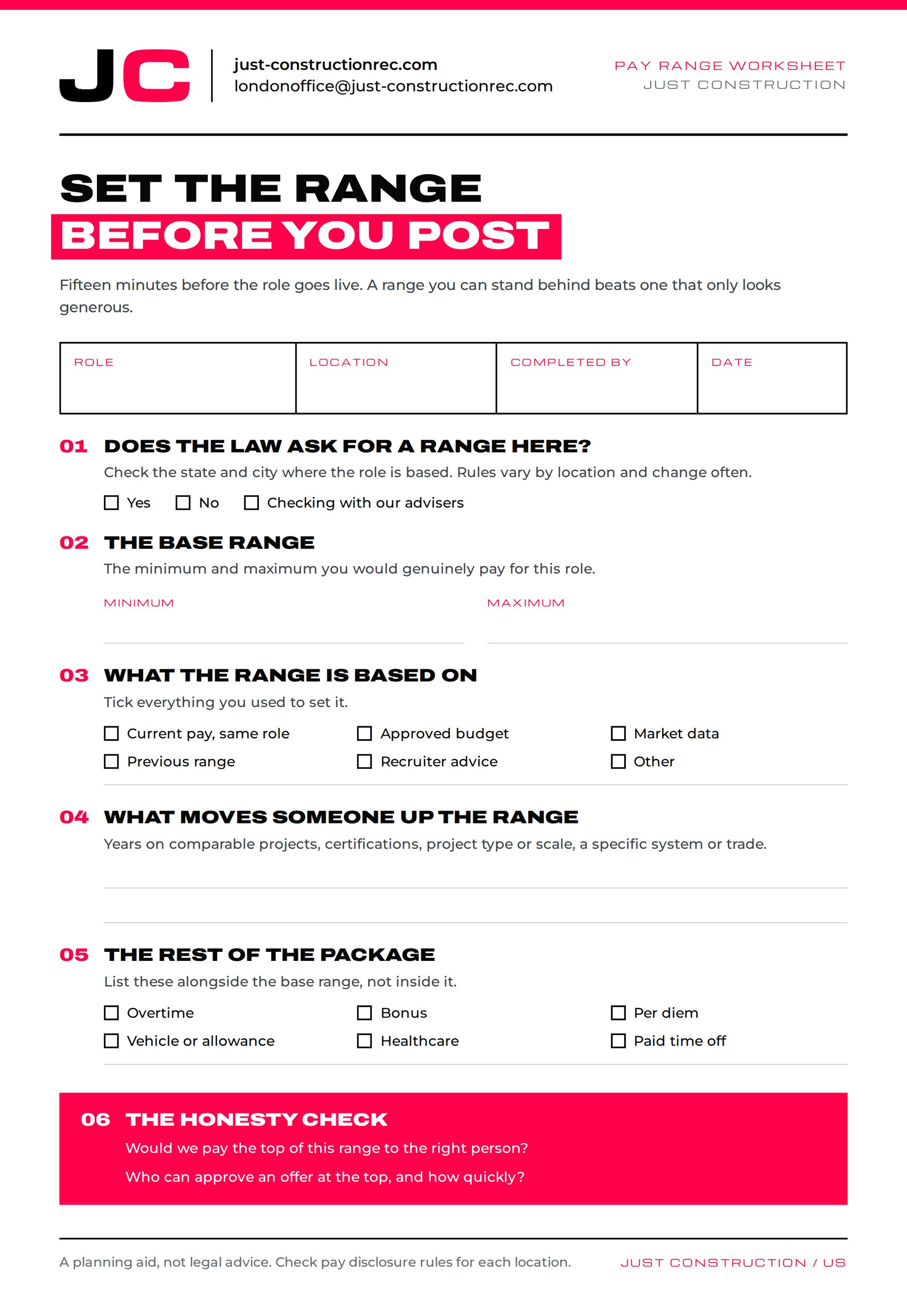
Know what moves someone up the range: Years on comparable projects, certifications, project type or scale, a specific system or trade. If you can say why one candidate lands near the top and another in the middle, your offers get faster and easier to defend.
List the rest of the package separately: Overtime, bonus, per diem, a vehicle or allowance, healthcare and time off all matter to candidates, especially in field roles. Keep them out of the base range so it stays clean, then spell them out alongside it.
Use one range everywhere: The figure on your careers page, the job boards, LinkedIn and your recruiter's post should all match. Candidates do compare, and Virginia's law covers internal postings and promotions too, so your current team will see the same number.
Make sure you can actually pay the top: The same Patriot survey found that 17% of applicants who saw a posted range received an offer below it. That is a quick way to lose a candidate, and an even quicker way to get talked about.
We have turned all of this into a one-page worksheet you can fill in before the role goes live.
How we help
When we take on a role, salary is one of the first things we pin down. We confirm the figure, ask where in the band you would ideally land, go through the package from time off to vehicle allowance, healthcare and bonus, and tell you honestly how it compares with what we are seeing in the market. Then the range goes on the post.
If you are planning a hire and want a second opinion on the range before it goes public, talk to our team. We will tell you where it sits, and whether the top is high enough to reach the people you actually want.
"Competitive salary" had a good run. It is time to put the number on the post.
Take the next step
If you are a business looking to for your next hire, a candidate looking for a new opportunity or just want industry information, get in touch.



READ MORE ARTICLES