Your Project Start Date Moved. What Happens to the Hiring Plan?
Your Project Start Date Moved. What Happens to the Hiring Plan?
Summary
Every construction professional has had some version of this email. "Quick update: the start date has moved."
Sometimes it is a week. Sometimes it is a quarter. Sometimes it is "to be confirmed", which is the construction equivalent of a shrug. Whatever the reason, whether it is permits, funding, equipment, design or something else entirely, the project team adjusts the schedule and moves on.
The hiring plan, though, often does not move with it. Candidates who were lined up for the original date are still waiting. Briefs written for the old timeline are still out in the market. And the recruiter may well find out last.
This article is about closing that gap. Not the big-picture story of why projects move, which we covered in When Projects Get Pulled, but the practical steps for when your own start date shifts.
Why dates move more than anyone would like
Start dates in construction depend on a long chain of things going right. Approvals, contracts, financing, design completion and, increasingly, equipment. We have written about how long lead times for MEP equipment are reshaping schedules, and they are far from the only cause.
The runway is long, too. The Dodge Momentum Index, which tracks nonresidential projects entering planning, is used as an early signal because planning tends to run a full year to 18 months ahead of construction spending. That is a lot of time for assumptions to change between a project being planned and a crew arriving on site.
None of that is anyone's fault in particular. It is just the nature of the work. The question is not how to stop start dates moving. It is how to keep your hiring plan honest when they do.
Step 1: Confirm what actually changed
Before telling anyone anything, get clear on the facts. Which date moved, and to when? Is the new date confirmed or still provisional? Does it affect every role, or just some? Has the scope, sequence or phase changed too?
That last question matters more than it seems. A six-week delay can shift which phase a new hire joins. Someone hired to start during construction might now be starting closer to commissioning, which may need a slightly different skill set. It is better to spot that now than after the offer.
Step 2: Tell candidates quickly and honestly
This is the step that most affects your reputation. Candidates who are part-way through a process, or who have accepted an offer, deserve to hear about a change as soon as it is confirmed. Not when the new date arrives. Not when they chase you. Now.
Tell them what changed, what is still certain and when they will hear more. If the new date is provisional, say so. If you do not know yet, say that too, along with when you expect to know.
And here is the important bit: do not ask candidates to hold their availability indefinitely. Experienced professionals plan their work carefully, and they may reasonably take another opportunity if your date moves significantly. That is not disloyalty. It is how the market works. Being honest about the uncertainty gives them the information to make a good decision, and it makes them far more likely to consider you again in future.
Step 3: Revise the brief
A moved date is a good moment to check that the brief still describes the job. Has the phase changed? The duration? The reporting line? The site?
If the answer to any of those is yes, update the brief and share the new version with your recruiter. It is a small step that prevents a big problem: a candidate who interviewed for one job and arrives to find a different one.
Step 4: Reset the plan with your recruiter
Once the facts are clear and candidates have been told, sit down with your recruiter and reset the plan. Which searches pause? Which continue? Which need a new timeline?
For each role, agree a checkpoint: a date when you will confirm, push or cancel. This is far more useful than an open-ended pause, which tends to drift into silence. A checkpoint gives everybody, including candidates, a clear moment when the picture will be updated.
It is also worth asking your recruiter what they are seeing in the market. If the delay pushes your start into a busier period, the candidate pool may look different when you restart. A short conversation now can save a slow search later.
What about candidates who have already accepted?
This is the hardest situation, and it deserves care. If someone has accepted an offer and the start date moves significantly, talk to them directly, as early as possible. Explain the change, confirm the new date if you have one and be honest about what it means for them.
What you can offer will depend on your organization and the terms of the offer, so involve the right people early. What you should not do is leave them waiting without information. A new hire who feels respected during a delay starts the job with trust. One who feels forgotten might not start at all.
When the date moves earlier
Not every change is a delay. Sometimes a start date comes forward, because an approval landed early or another project freed up a crew. It sounds like good news, and it usually is, but it puts pressure on the hiring plan from the other direction.
The same workflow applies. Confirm the new date, tell candidates what changed and check whether they can realistically meet it, including any notice they owe a current employer. Then reset the plan. An earlier start is only good news if the right people can actually be there for it.
A forty-eight-hour checklist
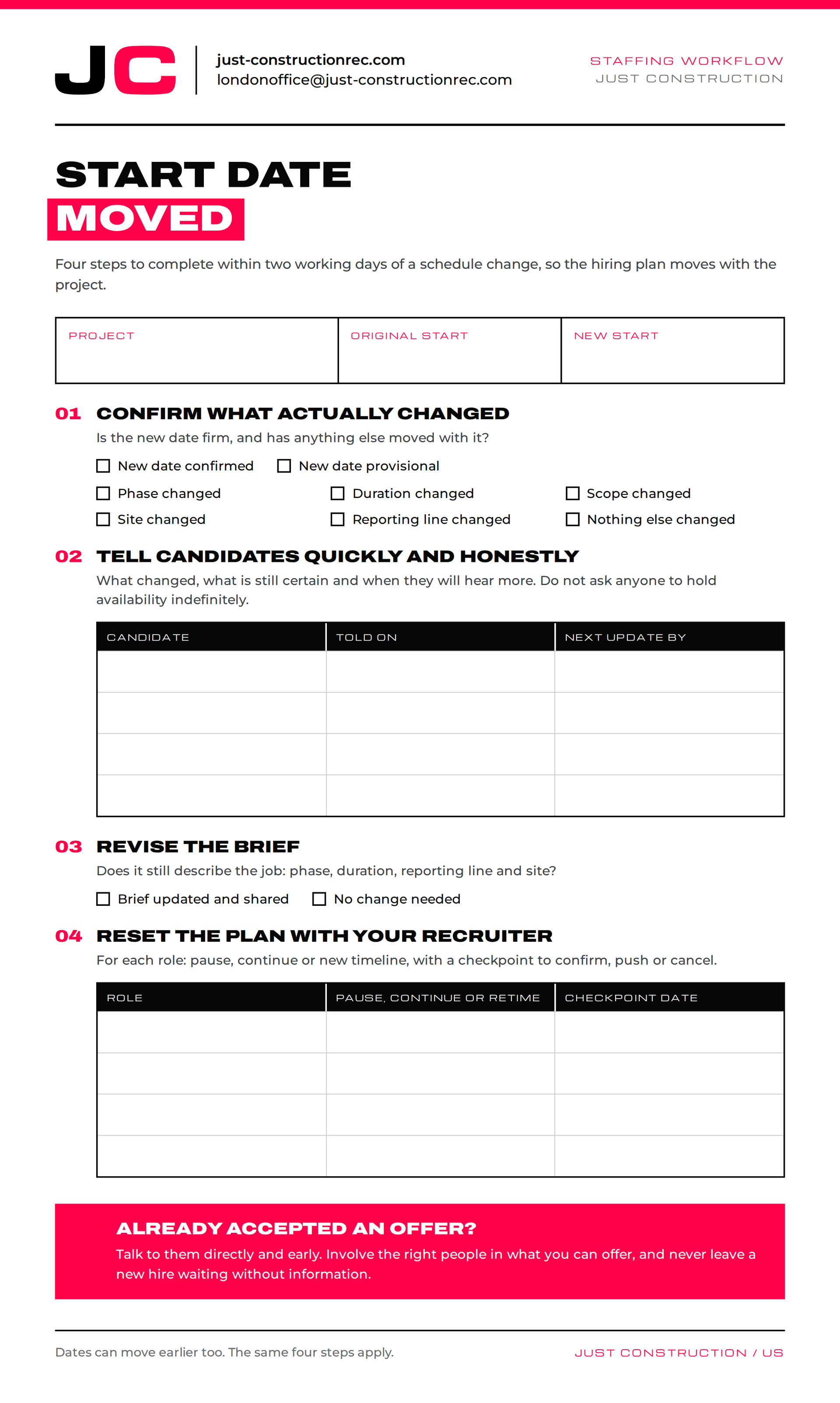
If a start date moves on your project, try to complete these steps within two working days. Confirm the new date and whether it is firm. Check whether the phase, duration or scope has changed. Tell every affected candidate what changed and when they will hear more. Update the brief if needed. And agree a checkpoint date with your recruiter for each role.
We have put this into a printable workflow below. It is the kind of thing that is easy to forget when a schedule change lands on a busy Tuesday afternoon, and very helpful to have ready when it does.
The cost of saying nothing
When dates move and nobody updates the hiring plan, the cost is quiet but real. Candidates drift away. Recruiters keep searching for a role on the wrong timeline. And the next time you contact those same candidates, some of them will remember how the last process ended.
Construction is a small world. The way you handle a delay says a lot about how you would handle a candidate once they are on your team.
How we help
When a client's start date moves, our US contract team works through the change with them: what is confirmed, what candidates need to hear and how the brief and timeline should change. We cannot promise that candidates will wait, and we will not pretend otherwise. What we can do is keep everyone properly informed, so the plan stays honest and the relationships stay intact.
The start date moved. The hiring plan can move with it, as long as somebody tells it to.
Take the next step
If you are a business looking to for your next hire, a candidate looking for a new opportunity or just want industry information, get in touch.



READ MORE ARTICLES