The Brief Behind a Better Contract Hire
The Brief Behind a Better Contract Hire
Summary
Here is a slightly uncomfortable truth. Some of the most important documents in construction recruitment are written in under a minute, usually on a phone, often while walking between meetings.
"Need a good PM for the new job, ASAP."
We understand completely. When you need contract support, you usually need it yesterday, and writing a brief feels like the last thing you have time for. But that one-line message leaves almost every important question unanswered, and every unanswered question becomes a phone call, an email or a mismatched candidate later on.
The good news is that a proper brief does not take long. It just takes the right five questions.
Why the brief matters so much for contract hires
With a permanent hire, there is usually time to adjust. The role can evolve, and the person can grow into it. With a contract hire, there is not. The contractor is there to do specific work in a specific window, and they need to be useful quickly.
That makes the brief more important, not less. And the market is not giving anyone much slack. In the AGC's 2025 workforce survey, 92 percent of construction firms trying to hire reported difficulty finding workers, and 45 percent reported project delays as a result. When good people are scarce, a clear brief is how you make sure the right ones say yes.
1. Deliverables: what will they actually produce?
Start with the work, not the title. What will this person deliver during the assignment? Close out a package, run a phase, manage a set of subcontractors, produce a set of documents, get a system ready for commissioning?
Be as concrete as you can. "Project manager" could mean almost anything. "Project manager to run the interior fit-out package on floors 2 to 5 through to substantial completion" tells a recruiter, and a candidate, exactly what the job is. It also tells you what success looks like at the end.
2. Reporting line: who will they answer to?
Name the person who will direct the work day to day. Not the department, the person. Then say who else they will work closely with, and whether anyone else can give them instructions.
This is especially important for contract roles, where the reporting line can sit across organizations. A contractor who knows exactly who their supervisor is on day one settles in fast. One who discovers they have three bosses with three sets of priorities spends the first week politely confused.
3. Start window: when do you really need them?
Notice we said window, not date. Give the earliest realistic start, the latest acceptable start and whether that timing is confirmed or still depends on something, like an approval, a contract award or a milestone.
This single change makes recruiting far more effective. Good contractors plan their availability carefully. If they know the window and how firm it is, they can make it work. If they are told "ASAP" and then the start slides by a month, they will quite reasonably take another assignment.
4. Duration: how long, and how certain?
Give the expected length of the assignment and what it is based on. A phase, a package, a fixed period? Then say how confident you are in that estimate, and what happens if it changes.
Contractors are used to uncertainty. What they appreciate is honesty about it. "Expected six months, tied to the fit-out schedule, which may extend" is a perfectly good answer. "Long-term, probably" is not.
5. Selection process: how will you decide?
This is the part most briefs leave out entirely. Who will interview? How many stages? How quickly can you give feedback? Who approves the hire, and are they available during the process?
For contract roles, speed genuinely matters. Experienced contractors often have more than one option on the table, and a three-week decision process can lose you a candidate who was ready to start in one. Agreeing the process upfront, including who signs off, is one of the easiest ways to avoid that.
Do not forget the site requirements
One more practical area often gets missed: what the contractor needs before they can start work. Site badging, background checks, safety orientation, system access and any certifications required on your project. If these take a week to arrange, your start window needs to allow for it.
Safety orientation deserves particular attention. OSHA is clear that host employers and staffing agencies share responsibility for the safety of temporary workers, including training specific to the host site's hazards. Writing those requirements into the brief means nobody discovers them at the gate on day one.
The bonus question: what does great look like?
If you have an extra two minutes, add one more line. What would make you say, at the end of the assignment, that this was a great hire? A package closed out early? A clean handover? A team that ran more smoothly?
This question does something clever. It forces the brief to focus on outcomes rather than credentials, which almost always leads to better candidates.
It also gives you something useful to come back to at the end of the assignment. Did the hire deliver what great looked like? If yes, you know what to ask for next time. If not, you know which part of the brief to sharpen.
Who should write it
Ideally, the person who will actually supervise the contractor. They know the work best, and they are the one who will live with the result. If a project executive or HR partner is coordinating the hire, that is great, but get the supervisor's input on deliverables and reporting line at the very least.
It is also worth sharing the finished brief with the candidates themselves. A contractor who reads a clear brief before the interview arrives with better questions, a better sense of fit and, if they take the role, a much faster start.
Common brief mistakes
A few patterns show up again and again. The wish list: fifteen required skills for a three-month assignment, most of which will never be used. The mystery reporting line: nobody is quite sure who the contractor will answer to. The floating start date: ASAP, but also pending an approval nobody has chased. And the missing decision-maker: the person who can say yes is on vacation for the next two weeks.
None of these is unusual, and all of them are fixable in the time it takes to drink a coffee.
Your printable intake brief
We have turned the five questions, plus the bonus, into a one-page intake brief you can fill in before you call a recruiter. It takes about fifteen minutes. It will probably save you several hours.
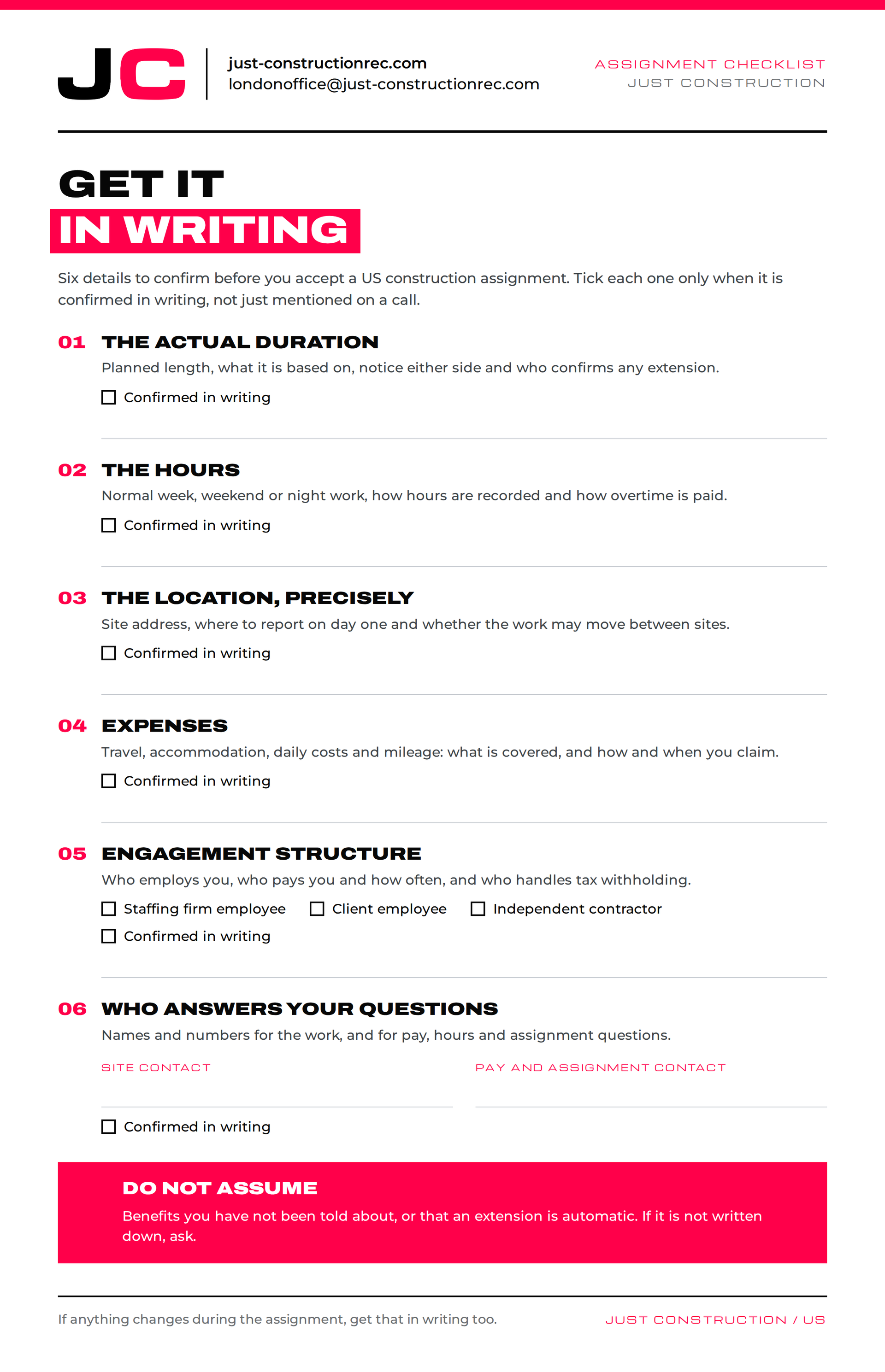
When you share it, include what is confirmed and what is still provisional. A brief with honest gaps is far more useful than one that looks complete but is not. We have also written about why construction recruiting has to evolve beyond permanent placements, and good contract briefs are a big part of making that work.
How we help
When you bring a contract requirement to our US contract team, led by Jodi Searle, Head of Contract Staffing, we work through these five questions with you before we start searching. If some answers are not ready yet, that is fine. We help you settle them, so the candidates you see are matched to the work rather than the title.
You do not need a finished brief to get started. Share your US contract staffing requirement, even if it is still one line long, and we will build the rest with you.
“Need a good PM, ASAP” is a fine place to start. Fifteen minutes later, it can be where a great contract hire begins.
Take the next step
If you are a business looking to for your next hire, a candidate looking for a new opportunity or just want industry information, get in touch.



READ MORE ARTICLES