Turn Your Project History into a Useful Data Center Resume
Turn Your Project History into a Useful Data Center Resume
Summary
Here's a small experiment. Open your resume and find the line about your most recent data center project. Now imagine a hiring manager who has never met you reading it for the first time. Could they tell, from that line alone, what you were personally responsible for?
If the honest answer is "sort of", you are in very good company. Most data center resumes we see describe where someone worked, not what they did there. Project names, campus sizes and job titles do a lot of heavy lifting. The actual work, the part a hiring manager is trying to understand, often gets squeezed into a single vague bullet.
This article is about turning that bullet into evidence.
Why data center resumes need more detail
Mission-critical hiring managers read resumes differently. On a data center project, the same job title can describe very different work depending on the phase, the package and which side of the project you sat on. A project engineer during early construction and a project engineer weeks away from integrated testing are having very different days.
So when your resume says "project engineer, data center, 2024 to 2026", the reader is left guessing. And in a busy market, guessing rarely works in your favor. The candidate whose resume answers the questions before they are asked is the one who gets the call.
The demand is certainly there. The Bureau of Labor Statistics projects construction manager employment to grow much faster than average over the next decade, and data center work is a big part of that story. More opportunity means more competition for the best roles, which makes a clear resume worth more than ever.
Five things every project entry should show
For each significant data center project, aim to cover five things. You do not need a paragraph for each. A few precise words will often do.
The work package: Which systems or scope were you connected to? Electrical distribution, mechanical cooling, controls, fire protection, structured cabling, the building shell? Be specific.
The phase: Were you involved in preconstruction, construction, commissioning, turnover or a live environment? If you worked across more than one, say which, and roughly when you joined and left.
The scope: How big was your piece of the work, in terms that make sense? The number of data halls, the systems, the crews or the subcontractors you worked with. Keep it relevant, and keep it to what you are allowed to share.
Your personal responsibility: This is the heart of it. What did you own, lead or deliver yourself? Use strong, honest verbs: led, coordinated, managed, closed out, tested, reviewed. And be clear about the difference between what you owned and what you supported.
The outcome: What happened as a result? A package handed over for commissioning, a punch list closed out, a test completed, an issue resolved. Outcomes do not need to be dramatic. They just need to be true.
A fictional example
To show how this looks in practice, here is a fictional example. It does not describe any real project, client or person. It is simply a model of the structure.
Before: "Electrical superintendent, hyperscale data center campus. Responsible for electrical works."
After: "Electrical superintendent, specialty contractor side. Construction through commissioning handover for electrical distribution in two data halls. Coordinated three foreman-led crews and the controls subcontractor. Led install sequencing and quality walkdowns; closed out the electrical punch list and handed over test-ready systems to the commissioning team."
The second version is longer, but not by much. And it answers every question a hiring manager would ask: which side, which phase, which package, what scale, what they owned and what they delivered.
Keep confidential details out
Many data center projects come with strict confidentiality obligations. So as a rule, leave out client names unless you are certain they are public and you are allowed to share them. Leave out site locations, security arrangements, equipment layouts and anything else that feels sensitive.
The good news is that you do not need any of that to write a strong entry. "Hyperscale campus" or "colocation facility" tells the reader the type of project. Your work package, phase and responsibilities tell them everything else. Handling this carefully also signals something useful to a hiring manager: that you will treat their project with the same discretion.
Say what you owned, and what you supported
One of the most common resume problems is the blurry line between the work you did and the work your team did. On a big project, almost everything is a team effort, and it is tempting to describe the team's work as your own.
Resist it. Not because anyone is being dishonest, but because it backfires. Interviewers will ask follow-up questions, and a candidate who has to walk back a claim loses trust fast. It is far stronger to say "supported commissioning readiness" and then talk confidently about it than to say "led commissioning" and struggle to explain the details.
We have written about why methodical construction professionals are in demand. Precision on your resume is one of the first places that trait shows.
Borrow the language of commissioning
If your work touched commissioning, it is worth being precise about which part. Data center commissioning is usually described in levels, running from factory witness testing through to integrated systems testing. Saying you "supported Level 3 pre-functional checks and Level 4 functional testing for the mechanical systems" tells a hiring manager far more than "involved in commissioning".
Just be careful to claim only the levels you genuinely took part in, and be clear whether you ran the tests, witnessed them or prepared systems for them. Those are three different roles, and experienced interviewers will ask.
Your most recent projects matter most
You do not need to give every project in your career this level of detail. Focus on the last two or three significant data center projects, plus anything older that shows a skill the target role needs. Earlier work can be summarized in a line or two.
This keeps your resume readable, and it puts the most relevant evidence right where a hiring manager will look first.
Use the worksheet before you write
It is often easier to gather the facts first and write the resume second. We have put the five elements into a printable worksheet, one project per page. Fill it in for each recent project, then turn the answers into short, clear resume entries.
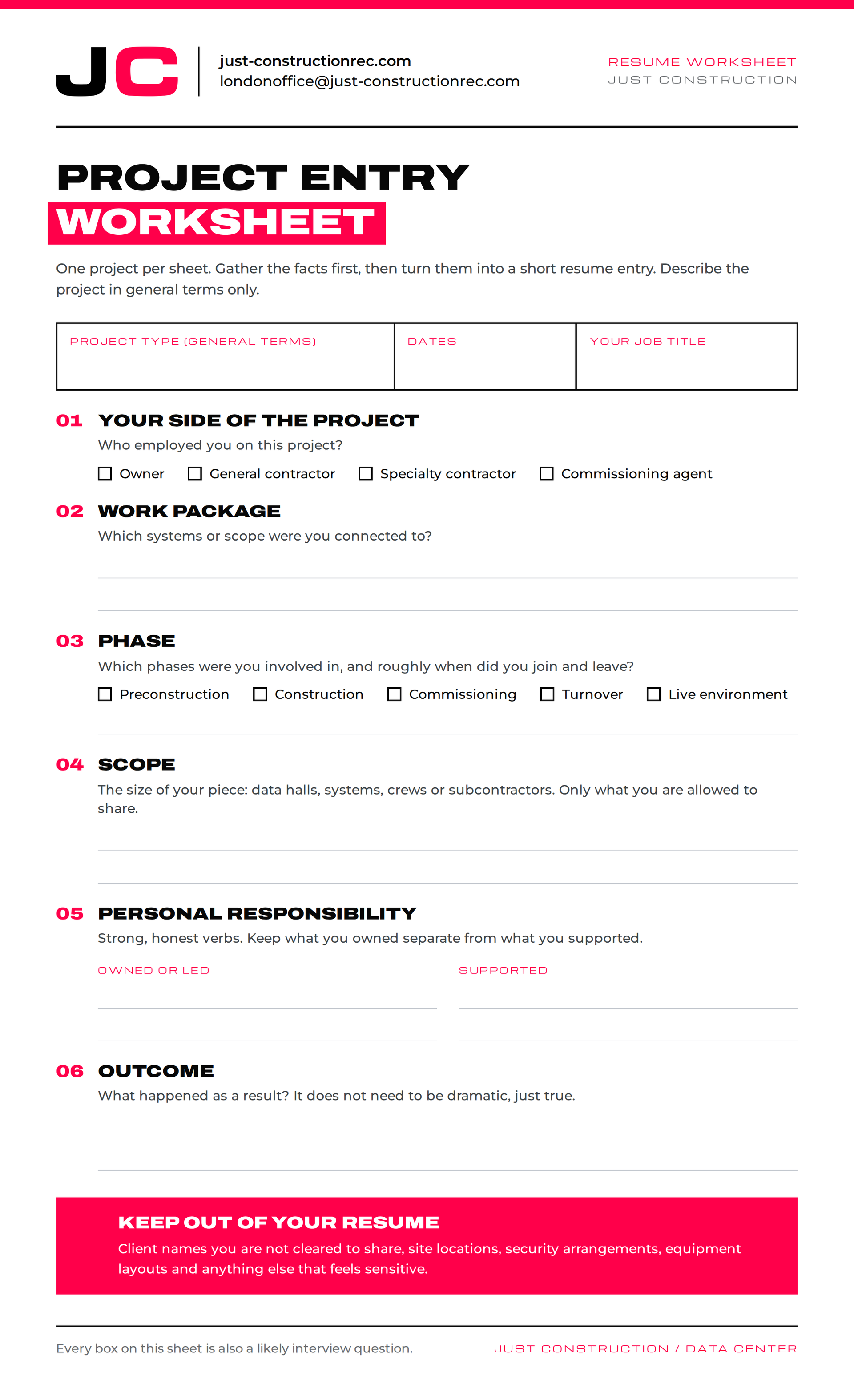
It's also brilliant interview preparation. Every box on that worksheet is a question you are likely to be asked, and having the answers ready makes the conversation far more relaxed.
This is about evidence, not visibility
We have written before about the most common mistake senior construction professionals make mid-career, and being visible in the market matters. But visibility gets you noticed. Evidence gets you hired. A resume that shows exactly what you delivered on real projects does both jobs at once.
How we help
Our Mission Critical and Data Center team reads a lot of data center resumes, and we are always happy to help candidates describe their project history clearly and accurately, without sharing anything confidential. If you have mission-critical experience, share it with us through our Submit Your Resume page and tell us what you have worked on.
"Data center experience" is a start. Package, phase, scope, responsibility and outcome is a resume.
Take the next step
If you are a business looking to for your next hire, a candidate looking for a new opportunity or just want industry information, get in touch.



READ MORE ARTICLES