How to Give Project References Without Sharing Confidential Information
How to Give Project References Without Sharing Confidential Information
Summary
There is a very modern construction dilemma that goes something like this. Your strongest recent work is on a project you are not allowed to talk about in detail. The client is confidential. The site is confidential. Half the drawings had a watermark on them. And now, right at the end of a promising interview process, someone asks for references.
Cue a mild sense of panic.
The good news is that confidentiality and great references are not opposites. Plenty of professionals give strong references for confidential work every day. It just takes a bit of preparation, which is what this article is about.
First, know what you agreed to
Before you share anything, it helps to know what you are actually bound by. Many projects, particularly in sectors like data centers, defense and advanced manufacturing, involve confidentiality obligations. A non-disclosure agreement is, as Cornell's Legal Information Institute puts it, an agreement where parties agree that certain information will remain confidential).
If you signed one, or your employment contract includes confidentiality terms, take a few minutes to re-read them. You do not need to become a lawyer. You just need a clear idea of what you can and cannot share, so you can talk confidently instead of nervously. If you are genuinely unsure, ask your employer or former employer what is permitted.
Ask permission, always
This is the golden rule of references: never list someone without asking them first. It is courteous, obviously, but it is also practical. A reference who is expecting the call gives a much better account than one who is caught off guard in the middle of a site walk.
When you ask, be specific. Tell them the kind of role you are applying for, roughly when they might be contacted and what you would like them to speak about. And check that they are comfortable doing so, especially if they still work on the confidential project. Some people may need to check with their own employer before agreeing, and that is completely reasonable.
Choose the right people
The best references are people who saw your work up close. A supervisor who directed your day-to-day work. A project manager who relied on what you delivered. A colleague from another trade who worked alongside you through a difficult phase.
The most senior name on the project is not always the most useful. A project executive may remember that you were there. Your direct supervisor will remember what you actually did. Hiring managers generally want the second kind of reference.
It also helps to choose references who can speak to the skills the new role needs. If the role is heavy on coordination, pick someone who saw you coordinate. If it is about quality and close-out, pick someone who saw you close things out.
Brief your references properly
Once someone has agreed, give them a short briefing. What is the role? What skills matter most for it? And, crucially, how would you both like to describe the project without sharing confidential details?
This is where a little alignment goes a long way. Agree a way of describing the work that you are both comfortable with. "A large mission-critical facility for a confidential client" or "a multi-phase advanced manufacturing project" gives the listener enough context without naming anyone. When you and your reference describe the project the same way, it sounds consistent and professional.
Describe your contribution, not the client
Here is the key insight. Hiring managers are not really asking about the client. They are asking about you. What did you own? How did you work with others? What did you deliver? None of that requires confidential information.
So focus your own descriptions, and your references' descriptions, on your personal contribution. The package or scope you were responsible for. The team you worked with or led. The phase you were involved in. The outcomes you helped achieve, described in general terms. You can say you closed out a punch list on schedule without saying whose building it was.
We have written about the most common mistake senior construction professionals make mid-career, and staying invisible is part of it. Being able to describe your contribution clearly, even on confidential work, is one of the best ways to stay visible without crossing any lines.
Prepare your own version first
Before your references are ever contacted, you will almost certainly be asked about the same project in an interview. So prepare your own description first, then share the approach with your references.
A useful structure is four short parts: the type of project in general terms, the phase you were involved in, what you personally owned and one or two outcomes. Practice it out loud. If you can describe the work confidently in under two minutes without naming anyone, you are ready, and your references will find it much easier to back you up with the same picture.
What to leave out
A simple rule of thumb: if you would not put it in a LinkedIn post, do not put it in a reference conversation. That usually means leaving out client names you have not been cleared to share, site locations, security arrangements, commercial terms, pricing, schedules and internal disputes.
And never share documents from a confidential project to prove a point, however tempting. A hiring manager who sees you respect confidentiality learns something valuable about how you would treat their project too.
When you cannot use anyone from the project
Sometimes the confidentiality is strict enough that nobody from the project can act as a reference, or the key people have moved on and are hard to reach. In that case, say so plainly. Explain the situation briefly, and offer alternatives: references from an earlier project, a previous employer or a colleague who saw similar work elsewhere.
Hiring managers in sectors with confidential work usually understand. What worries them is not a missing reference. It is a candidate who seems evasive. Being upfront about the constraint, and helpful about alternatives, solves most of the problem.
Keep your references warm
A final, often overlooked tip: look after your references. Thank them when they have been contacted. Let them know how the process went. And do not wear them out by listing them for every application. Save them for the roles you are serious about.
Good references are part of your professional network. We have also written about why construction professionals are switching recruiters, and relationships built on respect and communication sit at the heart of it. The same is true of the people who vouch for you.
Your reference preparation sheet
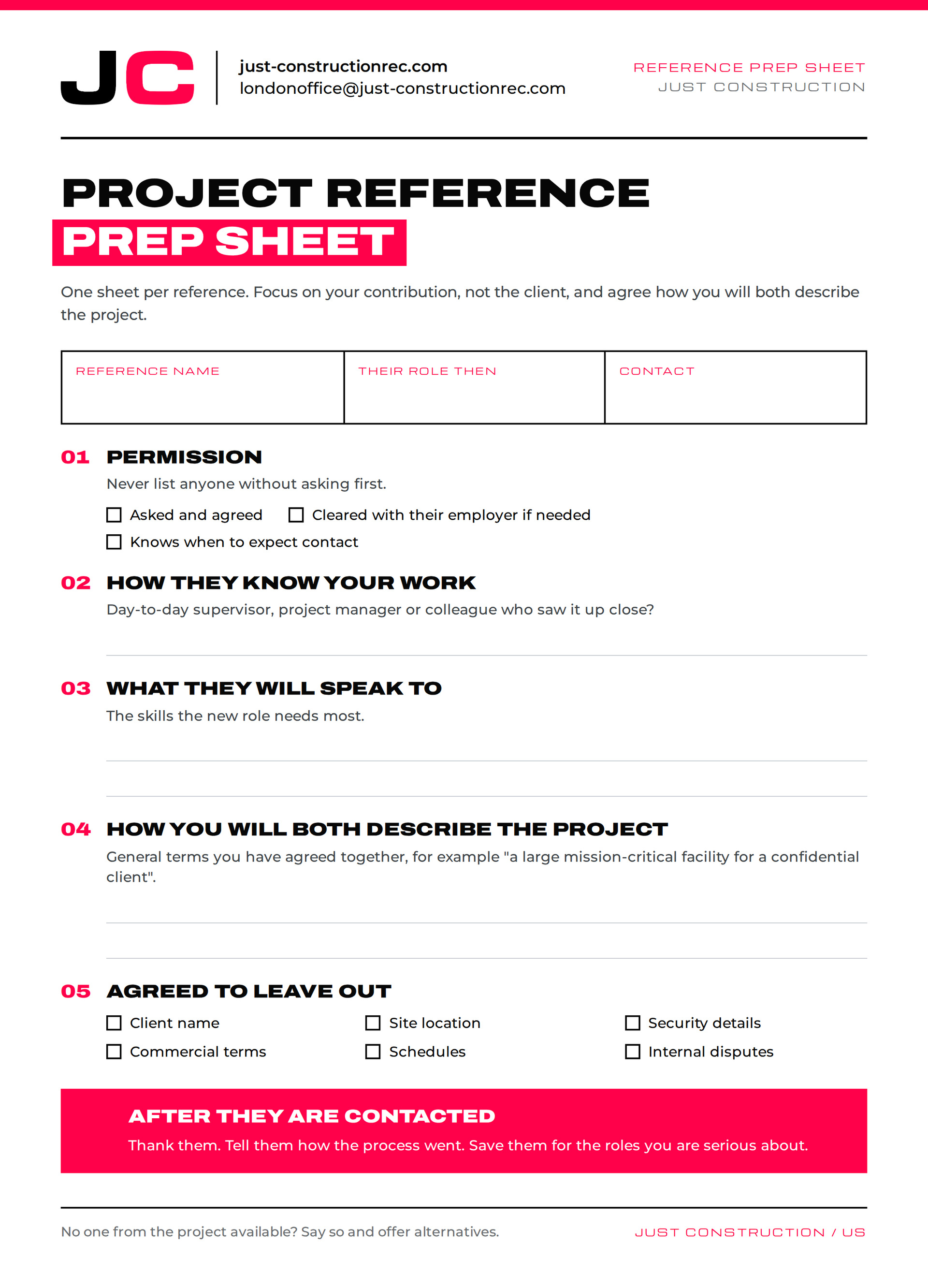
We've put all of this into a printable sheet you can fill in for each reference: who they are, how they know your work, what they will speak to, how you will both describe the project and what to keep out. It takes ten minutes, and it makes the whole process calmer for everyone.
How we help
When we work with candidates on US construction roles, we talk through references early in the process, including how to describe confidential projects appropriately. If you are thinking about your next move, we would be glad to hear from you, and our salary guide is a useful place to benchmark where you stand.
Your best project might be one you cannot name. Your contribution to it is still yours to talk about.
Take the next step
If you are a business looking to for your next hire, a candidate looking for a new opportunity or just want industry information, get in touch.



READ MORE ARTICLES