What Does Commissioning Experience Mean on a Resume?
What Does Commissioning Experience Mean on a Resume?
Summary
Of all the phrases on a data center resume, “commissioning experience” might be the hardest-working and the least specific.
It is valuable experience to have. But it can describe the commissioning authority who planned the process, the engineer who ran integrated systems tests, the contractor who prepared equipment or the technician who recorded the results. Each contributes something useful. The phrase alone tells you very little about which contribution you are hiring.
So when you see it on a resume, the next question is a simple one: “Which part?”
Why the phrase covers so much
Data center commissioning extends well beyond the final testing window. ASHRAE’s commissioning guidance describes a process running from predesign through occupancy and operation, built around the owner’s project requirements. Planning, verification and documentation all have a part to play.
Testing is commonly described in five commissioning levels, from Level 1 factory witness testing to Level 5 integrated systems testing. Between them sit installation checks, startup and equipment verification, and functional performance testing. The labels and boundaries can vary by project, so ask what the work involved as well as what level it was called.
Then there is the question of where someone sat in the project team. An owner’s representative, commissioning agent and specialty contractor may all have worked on the same facility with very different responsibilities. Sharing a project name does not mean sharing a job.
Why it matters so much to get right
Commissioning puts the project’s planning to the test. Uptime Institute describes it as an opportunity to verify system performance and prepare the operations team before the facility enters service. That depends on people understanding their responsibilities and the procedures they are working to.
If the experience you hired does not match the work you need, the gap can become clear during testing, with the schedule tight and the owner waiting for answers. That is an awkward time to discover that everyone meant something different by “experienced.”
Four things to find out
Before you get into individual examples, establish four things. Together, they give you a much clearer picture than a job title or a list of completed projects.
Which levels?: Ask where the candidate was directly involved, from factory testing through integrated systems testing. Find out whether they stayed through issue closure or handed over at an earlier stage. Being on the project while a test happened is different from taking responsibility for it.
Which systems?: Electrical, mechanical, controls, fire protection or a combination? Ask about the actual equipment and systems. Deep electrical experience may be exactly what you need, but it does not tell you how comfortable someone is with cooling systems.
Which side?: Were they working for the commissioning agent, owner, general contractor, specialty contractor or equipment manufacturer? Establish who they reported to and which decisions sat with them. That context helps you understand the scope behind their title.
What role within it?: Did they plan the tests, write the scripts, run them, witness them, prepare systems or record results? If they mention signing off, ask what they were accepting and what authority they held.
Build the interview around evidence
Once those basics are clear, move into examples. Keep the same core prompts across interviews so you can compare what candidates have done, rather than how confidently they describe it.
Walk us through a test you personally ran or witnessed. Which system was involved, what was the procedure and what did the results show? Ask what the candidate was responsible for, then give them room to explain. The detail is more useful than a polished overview of the whole project.
Tell us about an issue found during commissioning. How was it recorded, who resolved it and how was the outcome verified? Follow the issue through to closure. You want to understand how the candidate worked with other trades and what happened after the problem was spotted.
What documentation did you produce or review? Test scripts, checklists, issue logs, reports or systems manuals? Paperwork may not make the most exciting line on a resume, but it gives you something concrete to discuss. Ask how those records were used and handed over.
Where did your involvement start and stop? A precise answer helps you assess the person fairly. Someone who prepared equipment and supported startup should have room to explain that work without feeling they need to claim ownership of everything that followed. Ask for anonymized examples where project details are confidential.
Do not treat every commissioning role as equal
It is easy to treat commissioning as one qualification and assume that broader involvement always means a better fit. You can also overlook someone whose experience is relevant but described using different terminology.
Start with the work the position needs to cover. Preparing systems for testing calls for different evidence from overseeing a commissioning program. Decide which responsibilities the person must handle from day one and where support or development is realistic.
We have written about the value of systems thinking on data center projects. That wider understanding matters, but it still needs to connect to the systems and responsibilities in your vacancy.
Green flags and yellow flags
Listen for specific examples, clear responsibility and an explanation of how issues were closed out. It is also useful to hear how the candidate worked with the operating team. Handover is easier to assess when they can explain what the next person needed from them.
An answer that stays at “we commissioned the facility” deserves another question. So does uncertainty about level numbers or documentation. It may reflect a limited role, different project terminology or interview nerves. Ask for a specific example before you draw a conclusion.
Experience from outside data centers
Don't overlook hospitals, laboratories, pharmaceutical facilities or advanced manufacturing. Candidates from these environments may bring relevant systems knowledge and testing experience, even if their resumes do not use data center terminology.
Use the same questions to explore the fit. Establish what transfers, what is unfamiliar and what support they would need. A different sector should prompt a closer look, with the same scrutiny you would apply to any other candidate.
Be fair to candidates, too
A resume gives you a compressed version of someone’s work. Capable people can undersell their involvement, particularly if they have never been asked to explain it in this much detail. A structured interview gives them a fair chance to fill in the gaps.
Tell candidates beforehand that you will discuss specific commissioning examples. They can prepare without having to guess what you are looking for, and you can spend more of the conversation on the experience that matters.
A structured scorecard
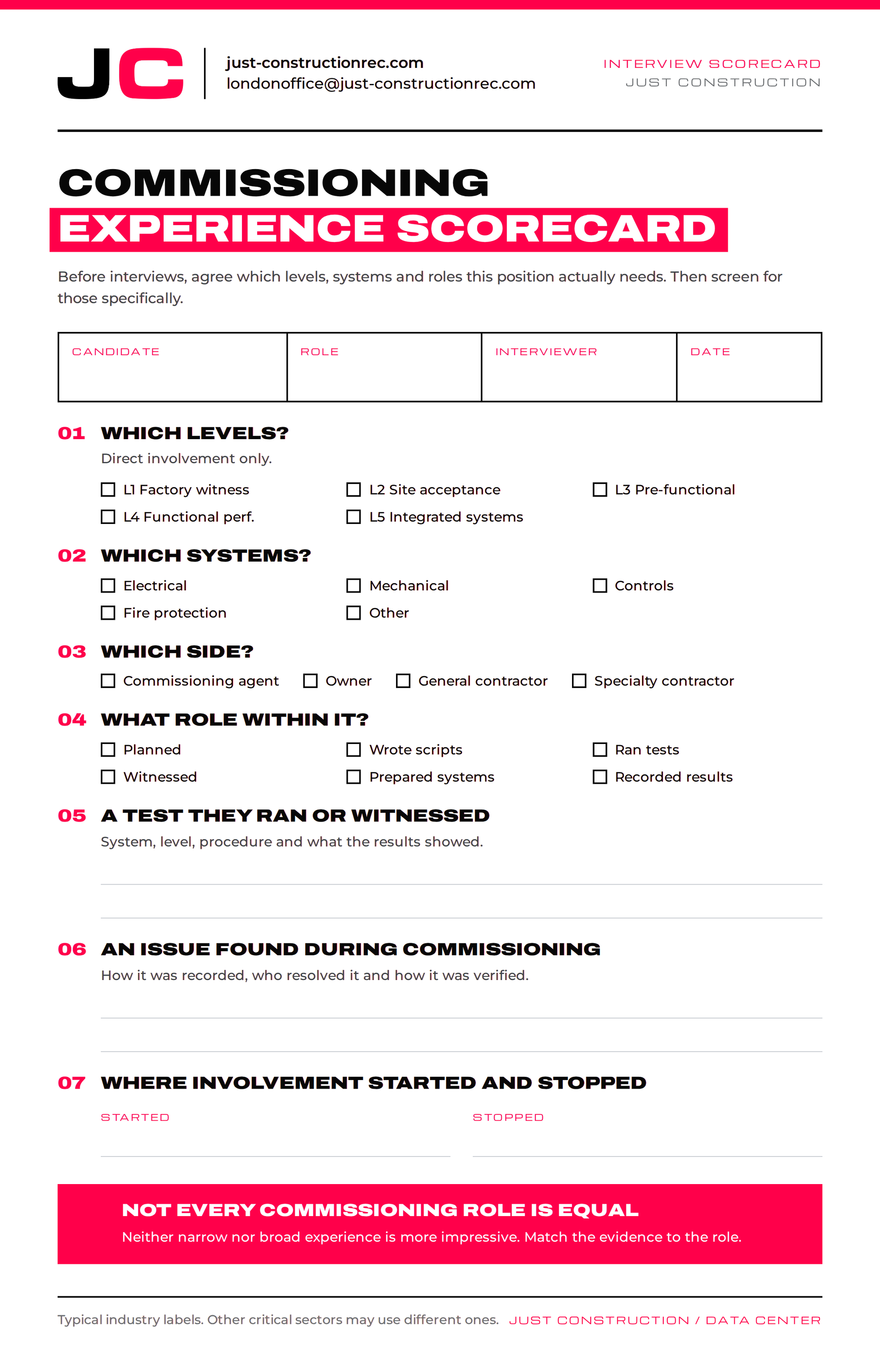
The printable scorecard below brings the four areas and evidence prompts together. Agree your priorities before interviewing and use one copy per candidate. Record examples alongside the ticked boxes, plus anything that needs a follow-up. It should help you compare relevant experience, not simply reward the longest list.
How we help
Our Mission Critical and Data Center team can help you work through the experience your next hire needs. Bring us the project scope and the responsibilities you need covered, and we can discuss what a relevant shortlist should look like.
“Commissioning experience” gets the conversation started. Knowing which part makes it useful.
Take the next step
If you are a business looking to for your next hire, a candidate looking for a new opportunity or just want industry information, get in touch.



READ MORE ARTICLES